More and more technology is changing our lives into something like that from a sci-fi movie. Soon flying cars, hover-boards, and robots will be an everyday part of our daily lives. Google is doing some amazing things to get us there too. It's very exciting and Google's Project Soli is one of those ideas that could catapult us into the realm of Star Trek or Back to the Future.
Project Soli is a new interaction sensor that uses radar technology to capture finger motions at 10,000 frames per second and it's unbelievably accurate. So accurate, that you could operate any device that's been fitted with this chip, without ever having to touch it.
The sensor is approximately the size of a small computer chip and it will transform your fingers into a virtual dial. You could control something as mundane as turning the volume up or down on a speaker, to something more advanced like turning your fingers into a virtual touchpad for a smartwatch or smartphone.
The chip is actually a miniature gesture radar and captures incredibly complex hand gestures at close range at mind-blowing frame rates. Given the nature of how small this chip really is, it's suitable for almost any device or any computerized machine.
Nation Geographic Magazine has been a staple in my family's home for as long as I can remember. I even had dreams of some day working for the magazine. My first dreams of being a photographer were stirred up from reading the publication.
Since 1888, Nation Geographic Magazine has been the official journal of the non-profit Nation Geographic Society which is headquartered in Washington, D.C. Things are changing though. Starting on September 9, the magazine is no longer non-profit thanks to a hefty $725 million deal with 21st Century Fox. This means Fox will own 73% of Nat Geo's media properties.
The Society began partnering with Fox in 1997 to launch the Nation Geographic Channel. After 18 years, Fox has moved into the position of co-owning the magazine as well.
It seems this has ruffled the feathers of many Nation Geographic Magazine lovers. Some are down right angry, and I get it. I can understand. I can also appreciate a good business move too. My hopes and dreams of working for the non-profit have not been dashed. As long as they continue to produce great content and enlighten us about the world we live in, I'm okay with that.
As we sit in the afterglow of all of Apple's announcements yesterday, I'm pondering the newest iPad. Apple's iPad Pro just might be a game changer for all kinds of people, and in particular, for photographers.
The iPad Pro has an incredible 12.9 inch screen. Apple claims that the display is the largest and best screen of any of their products. The 2732 x 2048 pixel screen is insanely amazing packing a total of 5.6 megapixels. By far, the new iPad Pro is the most powerful iPad yet. Apple even claims that it's more powerful than 80-90% of PCs sold in the last year. This new iPad is so powerful, it can run 3 4K video streams at once. There are many desktop computers, mine included, that struggle with that.
There's a smart keyboard, for those that prefer to type that way. It acts as a cover as well. But the most exciting accessory is the Apple Pencil. It's only $99 and from the looks of it, could turn your iPad Pro into something similar to a Wacom Cintiq. The Pencil can detect position, pressure, and tilt. The claim is that it's so precise, you can actually touch a single pixel.
All the players are in place. There's a great new iPad and a stylus to compliment it. Now, we just need some solid editing apps and this could really be a game changer for photographers and retouchers. Unfortunately, there are none. Adobe is promising "Adobe Fix", but there's no indication of where or not there will be any support for layers. They claim is can edit a 50 megapixel image.
If there is support for layers, then this iPad Pro will be everything that I'm looking for in a mobile device to add to my workflow. If not, then I will heave a huge sigh, shed some tears, and probably get a Cintiq or even a Surface. I'd love to stick with Apple, but I won't force it. Apple has laid the groundwork for a fantastic device. Let's see what the developers can create to compliment it.
The pixel packing race continues, as it always will. Nikon stunned us with the D800. Sony left us drooling with the a7R, and Canon upped the ante with the 5DS and the 5DS R. And now Canon has decided that just wasn't good enough. They've announced they are building a monstrous 120 megapixel CMOS sensor. Are you drooling yet? I'm not.
Canon also announced a 250 megapixel sensor that will be smaller than full frame, but larger than APS-C. While this sounds ridiculous, the camera is largely being geared towards industrial applications such as surveillance. Even though I can somewhat understand the reasoning behind this camera's development, I still scratch my head. At some point, it's just overkill. Why do we need all those megapixels? Are they really making our images better?
I've been on a less is more kick recently, and while I've always understood that ideal, I don't think it really ever sunk. I now find myself taking a hard look at my gear and questioning whether or not I really need it. More often than not, I don't. I have tons of modifiers that I don't use. I now have a DSLR that just sits, collecting dust, because I made the switch to mirrorless, and to be honest, I just haven't gotten around to putting it up on eBay yet. I'm a slacker, but that's a different story for a different time.
The American architect, Louis Sullivan coined the phrase, "form follows function". Do we really need all those megapixels packed inside a sensor? I feel the majority of the photographers and cinematographers would answer with a resounding, "YES!" Their reasoning being that the higher resolution will make better pictures or some such crap. My feelings on the subject have changed over the years. I really don't think it matters. Actually, it really doesn't. The images and video coming from iPhones and other comparable models, are really stunning. But they're packed with fewer pixels and a smaller sensor? Wait, that can't be! Oh, but it is.
Fuji hasn't changed their 16 megapixel sensor for some time and it's interesting to note that it out performed Canon's 5DIII in many areas. Again, smaller sensor and fewer pixels. Is there some kind of Fuji magic going on in there or is it just good old fashion science and engineering? It's probably the notion of, "fix the pixels you have instead of packing more in".
Time and time again we've seen artists in all mediums that have proven to us that it's not about the "gear" that makes the work, it's the person behind it. Or as my friend says, "It's not about the arrow. It's about the archer." So, while the world will wait, and sweat a little, for the announcement of this monster pixel camera, I couldn't care less. I say get out there and make pictures with whatever you have. Tell a story. That's the most important thing. And to illustrate this perfectly, take a look at this video. You're welcome.
Recently, I've been thinking more and more about downsizing. This goes for many aspects of my life. I started with my gear bag, but I didn't want to sacrifice quality. More and more I'm on the go and really hate lugging around a ton of gear and extras. Let's be honest, who really likes do that anyway?
Smartphone photography is incredibly popular, and with advancements in tech over the last few years, the quality output of these devices is only getting better. They pretty much render the small point and shoot cameras, well, pointless. DxO has released the DxO ONE, a 20 megapixel camera that attaches to your iPhone and allows you to capture impressive quality images from a device that fits in your pocket.
I saw this little doodad floating around on the web a few days ago and disregarded it. This morning, however, I decided to take a closer look. The DxO ONE is probably one of the first smartphone camera accessories that I would really like to own. I suppose it could be considered an accessory. It's actually a camera itself. It plugs into your iPhone via the lightning connector and uses your phone's display to view the images you're snapping. The camera itself is a 20 megapixel 1" sensor with a lens that is roughly 32mm . It has a maximum aperture of f/1.8. A nifty little extra is that the camera captures images in the DNG format. Those images are ready to imported and edited right away in Lightroom.
The accompanying iOS app gives you full control of the image taking process. You can choose from a number of different shooting modes or switch to fully manual for precision and creative control. The sample images look great! It's hard to believe you get all of this from something that fits right in your pocket.
The DxO ONE isn't a cheap accessory though. It's $599. It's a little on the pricy side for a mobile phone accessory.
Some of the biggest names in tech are teaming up to revamp the way video works on the internet. The roster includes Amazon, Cisco, Intel, Google, Microsoft, Mozilla, and Netflix. Interesting that Apple and Facebook are not on that list. Perhaps they will be at some point. The companies have come together to create the Alliance for Open Media. The group includes all three major web browser makers, of course excluding Apple and their Safari web browser.
The new format has yet to be named, but could make it easier for web giants to move away from using the antiquated Adobe Flash. It seems the world has been calling for it's death for some time, but Rocky Balboa, it just keeps getting up. There's more to this new concept than just being a replacement. It will be designed specifically for streaming video over the web with the idea being that it's suitable for low power devices. Again, interesting that Apple isn't on board with this yet, because for a while they didn't support Flash on their mobile devices saying that it was a power hog. The new format will also support copy protection. This makes perfect sense for companies like Netflix. The cherry on the top is that it will be royalty free. Open source and royalty free? Huzza!
The risk overall is that this creates confusion with yet another standard for companies and developers to handle. Adoption rate will likely be slow, the haters will hate, and the general public may not know the difference except when they go to view a video and receive the error that says the format is not supported. Could be worse, I suppose. The concept does make sense though. Finding a way to implement a new standard that is advancing along side of the ever-changing tech is the only way to go. Only time will tell.
Yesterday, we lost a great creative soul. Wes Craven, the legendary director of "SCREAM" and "A NIGHTMARE ON ELM STREET", passed away at the age of 76. According to The Hollywood Reporter, Wes had been battling brain cancer.
Even if you don't know or recognize the name Wes Craven, you know who him. Wes was the genius behind box-office smash hits like the aforementioned films. Both of which went on to have numerous sequels. In particular, "SCREAM" is credited with reinvigorating the teen horror film. Honestly, it was hard not to like the tong-in-cheek script that parodied and praised the genre. It was just plain fun and wet your pallet for more. The numbers proved that statement true for many people. Before long, "SCREAM" became one of 1996's highest grossing films, and this pretty much cemented Craven as the influential writer and director of exploitation films. He did make a break from his signature genre with the 1999 drama "MUSIC OF THE HEART" for which Meryl Streep earned an Oscar nomination.
Wes was born in 1939 in Cleveland, Ohio. He went on to earn a masters degree in philosophy and writing from Johns Hopkins University. He did teach college for a brief time, but then ventured into cinema, and the world would be a different place because of it. It was not long before Craven established himself as an auteur who imbued his creepy films with questions about the nature of our everyday existence. Truthfully, I wanted to have his kind of career. He was making exciting films and posing questions that we usually associate with heavy dramas or quirky type comedies. It was pure brilliance.
At the time of his death, the Craven produced MTV series based on "SCREAM" was only days away from airing it's season 1 finale. Alas, there is no plot twist here. Rest in peace, Wes.
There's another contender in the mirrorless market. One that could be a winner. After longer than I'd like to admit, I finally jumped ship from traditional DSLR to mirrorless last week, and I haven't looked back. I love the technology, the compact size, and the quality is amazing.
Canon now announces the EOS M3. It's the much improved 3rd generation addition, and with the new additions, it just might be a contender for best in class. With a 24 megapixel APS-C sensor combined with a Digic 6 processor, it provides an ISO range of 100 - 12,800. And of course, you'll also find that this camera will handle 1080p@24/30 video just the way a Canon should. At least on paper, it should. The focusing system is up to snuff, too. There's a 49 point phase and contrast detection autofocus system. To close it out, you'll also get WiFi capabilities. Seems all gravy to me.
But wait, there's more. There's a touch screen along with front and rear adjustment dials. Now we're talkin'. The overall design remind of the Sony a6000. It's got a good look and seems like it would fit well in the hand. We'll have to see. Pricing isn't bad either. Actually pretty good. $679.99 for the body only.
If you're a fan of mobile photography and also like getting creative, LENSBABY has just released mobile lens attachment that will add a few more creative options to bag of tricks. Personally, I think this is great! Currently there are only three lenses options for the kit, but I'm sure LENSBABY will be releasing more as time goes on.
The first gives you a small sweet spot with gradual falloff to blur. The next has a larger sweet spot with the same gradual falloff to blur. The last lens has a strong, sharp focus in the center with a kind of kaleidoscope reflection around it. Looks pretty nifty, honestly. The creative kit even comes with a little kickstand so that you can prop your phone up. It looks like this is all you need to make some mobile magic.
The cost of the kit is $89.95. Not terrible, but not great either. I might have to give this a try as it looks easy to travel. Not a lot of components and such, which means it's something you could easily stuff in your pocket or camera bag. Most importantly, this looks incredibly fun, and that's what we need in our work. If it's not fun, then why the heck are we doing it?
Fuji has made an app that allows you to test all of their lenses on your smart phone or tablet before you buy. That's pretty nifty, if you ask me. If you're trying to make a decision on what focal length or how a particular image would look with a particular lens, this app will let you test it out. I suppose one could rent a lens before hand to truly get the right info, but Fuji has made something that at least puts you in the ballpark of understanding. You get enough information to make at least a smart decision.
The app allows you to select the lens and aperture you want, and then allows you to take a virtual picture. If you select a zoom lens, the you're also allowed to choose your focal length. After you take a virtual picture, it's displayed with all the settings. Now it gets a wee bit interesting here. Take the same picture with a different focal length and add them both to your lightbox for comparison. That's handy when trying to make a choice.
The app also lets you look at the work of other X-Pro Photographers. I'm making the switch to Fuji myself, so this app might come in handy for making lens decisions.
Here's a kicker. Google is changing their name. No joke. Yep, our favorite verb is no longer the name of a very forward thinking company. On Monday Google announced that it was changing it's name to Alphabet, a name that encompasses a company that's made up of so many parts. Fear not though, the search engine will remain separate.
So, why the move? Google has become so much more than just a search engine. They are a massive conglomerate that has their hands in everything from drones to pharmaceuticals to even venture capital. Google seems to have their hands in almost everything. And it makes sense. The company is like a mad scientist in his lab dreaming up crazy ideas and then making them real.
The name Alphabet is meant to allow all the separate parts to be independent and develop their own brand. Over the years the world has come to recognize the Google banner as just the search engine. It would be hard for the robotics and artificial intelligence devisions to do that because they may never be consumer oriented. Google's co-founder, Larry Page, wanted an umbrella company that gave the individual parts the freedom to fly.
If you want to take a peek at the company's new site, you won't find it at alphabet.com. That site is owned by BMW and as of Monday evening, the site was very slow to load. I'm guessing that was because of all the new traffic. People Googling to find it. You'll have to surf on over to abc.xyz to find the new company site. Also, it would seem that the owner of @alphabet on Twitter is probably receiving a bunch of new friends. Looks like his Monday went very well.
You have to hand it to Google, they like keeping it fresh. And if you don't believe me, you can Alphabet that.
I know I'm not the only one that has attempted to snap a photo of something I find interesting, but find there's some kind of...something in the way. A tree or a fence or even a reflection when shooting through a window. You're excited about the shot, but know that darn reflection is killing the frame.
If you're Photoshop savvy, it's possible you might be able to repair it, but not certain. If you're not, then you're just left with an obstructed image that could have been great. Recently, a software has been developed that just might solve this problem for all of us. The video above will give you an idea of what's going on. It hasn't been released, nor is it perfect yet, but it's definitely headed in the right direction.
Stuff like this gets me excited. I love seeing people create and discover new technologies. Enjoy!
Look out world! He's coming our way so very soon. The new DeadPool trailer dropped recently and I have to say, I'm pretty excited about it. It looks fun, witty, and full of amazing comic-carnage. Yep, I will be watching this flick when it hits theaters. Will you?
I'm a Mac user. Always have been. I'm not such a fanboy to think that one system is better than another. That's just ridiculous. I love the Apple environment. It works for me, and that's all I need. I used to get worked up over the argument about viruses and Macs. Now, I just shrug it off because it's pointless really. Macs are not immune. There's no super power that this particular machine has when it comes to dealing with viruses. The people concocting these viruses just aren't really making them for Mac. Theres less of these machines in the market place.
I saw on WIRED the the world's first firmware worm that infects Macs was announced. I'm guessing Windows fanboys and gals everywhere are rejoicing. Let the finger pointing begin. It makes me giggle. A worm is essentially a sub-class of a virus and can travel from computer to computer, but the kicker is that it can travel without human interaction.
The video above will give you a good idea of what happens. It basically changes the code built into the motherboard which means that swapping the hard drive will have no effect and neither will reinstalling the OS X. Apple has started patching these security issues, and I'm sure they will completely patch this all up in the near future.
So this is interesting. Nokia, the glorious cell phone manufacturer from yesteryear, is taking a step into the world of virtual reality. Does that strike you as odd? If so, I'm right there with you. However, this is a pretty nifty development. Nokia partnered with Jaunt VR, the virtual reality camera developer, to create the Ozo. I have a feeling that all the credit belongs to Jaunt VR though.
This 6 pound little ball is boasting some cool specs and next gen technology. We're still in the early stages of 3D and virtual reality. This new camera presents some very groovy possibilities. The Ozo has 8 lenses with global synchronized shutters, 8 integrated microphones, 3D stereoscopic video recording, and immediate low resolution stitched video review. Just imagine the possibilities. The synchronized shutters bit is especially exciting. That will save so much many post production headaches.
Here's a little teaser video that gives you absolutely nothing, but it's a cool promo all the same.
If you're a gearhead, prepare yourself. I'm not going to lie, I nearly had a gear-gasm when I saw this announcement. Canon has decided to one-up Sony's a7s, and boy did they ever. The ME20F-SH is Canon's first multi-purpose camera "which delivers exceptionally high sensitivity to capture Full HD video with a minimum subject illumination of less than 0.0005 lux1 (at maximum 75 dB gain setting, equivalent to an ISO sensitivity of over 4,000,000)". Blah, blah, blah. If the tech talk loses you, just know that what this means is that you can shoot 1080p and see subjects that you can't see with the naked eye. That's insane! No, ridonkulous!
Canon is targeting a large audience with hot little number. This camera could have a place in the infrastructure of productions that range in nighttime surveillance to reality TV, to even cinema. Typically, Canon does a great job delivering when it comes to image quality. So, I'm guessing they won't disappoint here as well.
The sensor is a modified and enhanced version of a 35mm full-frame sensor for HD video they developed back 2013. Get ready for the kicker - it's only 2.26 megapixels! I found this very interesting. It seems everyone has been in this pixel packing race over the last few years and it's nice to see that Sony and Canon are showing us that it's not about the quantity, but the quality and use of those existing pixels. So, it's not about the size, but it is...Take that how you will.
Take a peek at the specs below. Pretty interesting.
Canon says the ME20F-SH will be available in December of 2015 with a whopping $30,000 price tag. I think I'll be renting for sure.
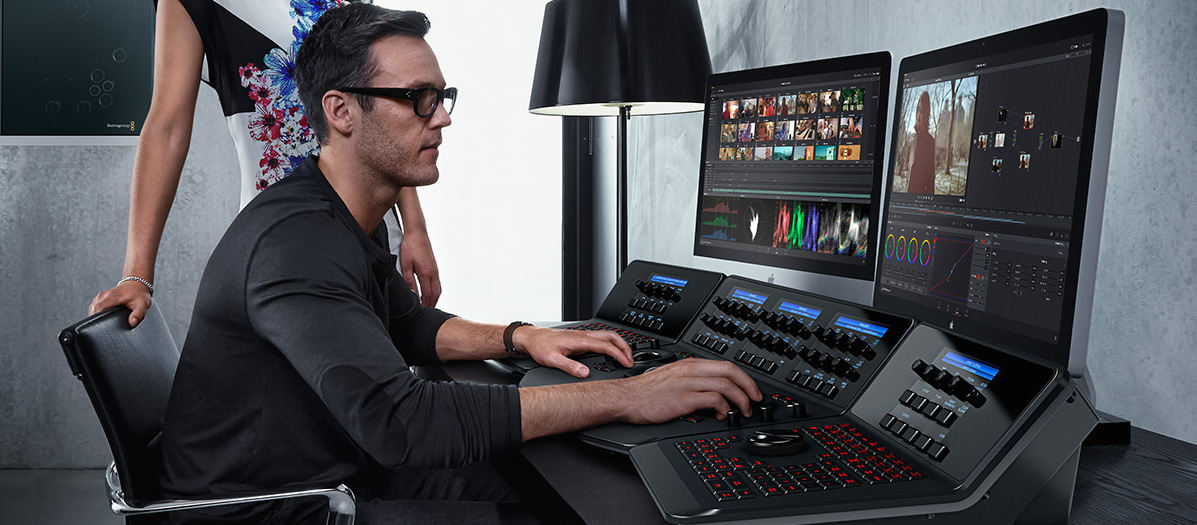
I'm a fan of BlackMagic. They're a great company with a great line of products. Their cinema cameras are fantastic. Especially for the budding filmmaker. The cost of buying is so cheap, and rentals on them are even better. Their post-processing software, DaVinci Resolve, is a beautiful piece of software which turns out amazing results. What's not to like?
Earlier this year BlackMagic announced the recent update to DaVinci Resolve, and now they want to share it with you. For free! Yep, you heard me right. Granted, there has been a free version since Resolve 11 (the update available is 12), but BlackMagic is doing a great job of pushing this out there. They want you to be a video editor! So give it a try.
DaVinci has widely been a choice for color grading in Hollywood for a while. Many of the editors that I've spoken with really enjoy it. The free version doesn't give you the full functionality of the pro version, which is $995, but for those in the market for a free software don't really need to be concerned with 4K output and such. For a full list of specs and info check out the BlackMagic site. Oh, and by the way, that awesome looking workstation, is $29,995. My wallet just exploded.
Intel and Micron have a new brain child. It's a new way to store data and they claim it's denser, tougher, and faster than the competition. What's even more exciting is that it's already in production. Intel's new chip brings about the first new memory category in more than 25 years.
There was a live keynote yesterday in which the companies announced 3D Xpoint, which is a new category of non-volatile memory that claims to be 1,000 times faster than NAND. NAND architecture is the underlying structure of most flash memory cards and solid state drives. If you want to see more on the specs and features of this ground breaking new tech, surf on over to Intel's website here.
I'm a big fan of Sigma. Their line of art lenses are beautiful. The build quality is solid, the glass is amazing, and the images they produce are nothing short of beautiful. They continue to amaze with every release. That is until now.
Not too long ago, Sigma announced the release of the world's fastest full frame zoom. Exciting as it sounds, it's all very...well...it's...for starters, it's fast and it's...well, damnit! It just doesn't make sense at all. I can't hold it in. The damn thing is pointless. It's a 24-35mm f/2 lens. Wait for it...give it a second to sink in...a24-35mm! Yep. You read that right.
The range this zoom will give you is just silly in my opinion. Not only that, it weighs in at 33 ounces. So it's big and it's fast. Huh. Okay. Sigma said it released this to cover a common prime lineup. Only it's not a prime, but that's no matter. It's the range that makes absolutely no sense. Why not get your hands on a beautiful 28mm prime and be willing to move your feet forwards or backwards? I mean, that's exactly what this zoom range equals.
Sigma is offering this very pointless lens for a very low, low price of $999. In theory all of these things would give a photographer GAS, and I'm sure there will be plenty of photographers lining up to pre-order. I want to love this, but I just can't. It just doesn't get my motor going.
The art of photography is priceless and the cost of creating it is nearly the same. Cameras, lenses, speed lights, strobes, modifiers, software, plugins. The list goes on and on. Finding budget friendly options isn't always easy, especially when it comes to quality. One company is specifically tackling that problem. Rocket Rooster is that company.
Rocket Rooster is a digital filter company that produces incredibly affordable plugins for Adobe's Creative Suite. They first produced a number of different styles for cinema purposes and the quality looks pretty good. They then decided to set their focus on creating products for photographers using Lightroom and they're latest release, the Analog Film Pack, just might give VSCO a run for it's money, or rather your money.
The pack includes 20 old school film presets with over 100 variations there after. Like the VSCO, Rocket Rooster's film emulations allows digital photographers "to create the subtle nuances in color, texture and feel of analog photography." Within the variations you'll find expired and faded rolls, and Rocket Rooster even threw in some cinema film stocks for some really unique looks. For a full list of what's included in the pack, check that out here.
FJ Provia 400X Alt
Kodak 400 TX
Ektachrome E100 GX
Agfa Vista 800
FJ Provia 400X
Kodak Ultra 400UC
FJ Velvia 100
VSCO has long been the heavy weight champion when it comes to the world of film emulations. I have them. I use them. They're beyond amazing! But, let's face it. They're not cheap. Their emulation packs cost $119 each and that can add up if you're interested in getting your hands on as many options as possible. That's money many of us could put towards new gear or just your daily bills.
Like the VSCO, Rocket Rooster's film emulations allows digital photographers "to create the subtle nuances in color, texture and feel of analog photography." But the cost is significantly less. If you're interested, you can pick up the pack for $35 (as a promo the RR is offering it discounted to $26 for the launch, but you'll have to act quickly. I believe it's only for a week.) These emulations look great to me and you can't beat the price.